Pages

Sunday, March 20, 2016

Open Post #7: Careers in Physiology


I read an article about typical careers that someone can have with a physiology degree and it was very helpful. Contrary to popular belief, along with the many careers you can choose involving the medical field, there are also many careers you can choose that aren’t in the medical field. A career in the medical field is the most common, but there are other jobs in science and pharmaceuticals and teaching and education that someone can get with a physiology degree. It is not required of someone with a physiology degree to go medical school or some type of graduate school. Here are some of the options for careers requiring a physiology degree:


Photo credit: phsl.otago.ac.nz


Careers directly related to a physiology degree:

  • Biomedical scientist
  • Clinical research associate
  • Exercise physiologist
  • Healthcare scientist, audiology
  • Healthcare scientist, physiology
  • Pharmacologist
  • Research scientist


Careers where a physiology degree would be useful:

  • Medical sales representative
  • Physiotherapist
  • Science writer
  • Secondary school teacher
  • Therapeutic radiographer


Some typical employers of people with a physiology degree are:

  • Research centers
  • Academic institutions
  • Pharmeseutical and biotechnology companies
  • The National Health Service
  • Private sector hospitals, healthcare centers and healthcare organizations


Non-science employers include:

  • Management consultancies
  • Law and accountancy firms
  • Banks and financial institutions
  • Retail companies


At first, I assumed that most all of careers someone could get with a physiology degree would be in the medical field. After reading this article, I realized that there are any more options. This makes me happy because now I know I have many options and ways to do what I love to do. This article was really helpful with finding jobs requiring a physiology degree, it may be helpful in finding jobs for other degrees, too! Hopefully you check it out!


AGCAS Editors. "What Can I Do with a Physiology Degree? | Prospects.ac.uk." What Can I Do with a Physiology Degree? | Prospects.ac.uk. AGCAS, Sept. 2015. Web. 20 Mar. 2016.


Thursday, March 17, 2016

Prompt #7: Contemplating Controversy


I have found an article that talks about one of the most popular medical controversies in 2014: does a gluten-free diet really benefit people? This article argues whether or not going on a gluten-free diet actually helps people.


Photo credit: geneticliteracyproject.org


One side says that a gluten-free diet benefits anyone who does it. Getting rid of all of that sugar from ones diet can always be beneficial. Some people feel better when they eliminate gluten from their diet and it give them more motivation to be healthier and exercise.  


The other side argues how becoming gluten-free only benefits 1% of our population. This is because being gluten-free does not matter unless you are that 1% that is diagnosed with celiac disease. People with celiac disease have small intestines that cannot digest gluten correctly and it affects their digestive system. They say that going gluten free does not provide any health benefits unless you have celiac disease or you are just allergic to gluten. Cutting a whole nutrient out of your diet is not helpful when you are trying to lose weight. They also say that gluten is not harmful and it doesn’t affect your weight at all. Weight loss starts with a healthy diet, not just cutting out gluten.


These arguments are both very convincing, but only one is actually true. The articles I found on this topic both did a good job of arguing from different points.


"Medical Controversies Sparking Debate in 2014." CBSNews. CBS Interactive, 1 Jan. 2014. Web. 17 Mar. 2016.

"Myth Buster - Does a Gluten-Free Diet Aid In Weight-Loss? - JillianMichaels.com." JillianMichaels.com. Jillian Michaels, n.d. Web. 17 Mar. 2016.

Thursday, March 3, 2016

Prompt #6: Evaluating Sources


I have found scholarly article from the journal “Physiology” from the American Physiological Society. It is titled “Why Physiology Matters and Medicine”. In this article, Michael J. Joyner, M.D., Professor of Anesthesiology at the Mayo Clinic, argues about how teaching human physiology to medical students is still very important.


As time goes on, physiology courses are being changed to make them medical related rather than keeping the basics of physiology and human anatomy within these courses. He says that students learning about physiology is critical and it cannot be forgotten about. It has been said that medical educators don’t believe that knowing this information is as useful as it used to be and it will not help with new discoveries.


Photo credit: designhealth.com


I agree with Dr. Joyner, taking physiology courses is so important when it comes to the medical field. I don’t understand how anyone could go into the medical field without knowing this information. It is vital to know the human body and its functions, how else would one be able to learn and explain new discoveries? Dr. Joyner has made a valid argument and I hope in the future that he, or others, do something about this. I think physiology is so important to know, especially when someone is trying to become a doctor.


Every medical school student needs to be taught physiology correctly so they can become reliable doctors and caregivers for our society.


""Why Physiology Matters in Medicine"" American Physiological Society. American Physiological Society, 16 May 2011. Web. 3 Mar. 2016.


Open Post #6: The Organ Systems of the Body


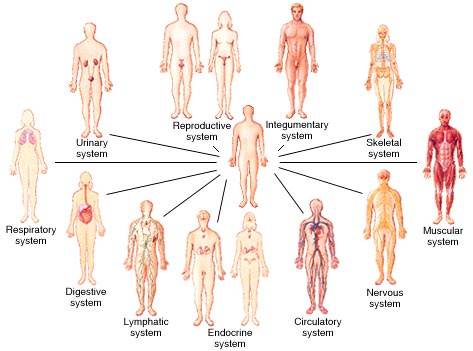
In this post, I will be talking about the organ systems of the human body. I read an article about this and I figured since my blog is about physiology, I should share some of the information!


There are 11 organ systems in the body and there are all very important. Even if you’re not a physiology major or someone interested in the medical/health field, you should know about the organ systems!


Photo credit:anatomyandphysiologyi.com


So, here they are:

  • The Integumentary system: forms the external body covering and protects deeper tissues from injury. Examples: skin, hair, and nails

  • The Muscular system: maintains posture and produces movement (locomotion). This system also produces heat. Examples: skeletal muscles

  • The Skeletal system: supports and protects the body’s organs. It also provides a framework for muscles. Examples: bones, joints

  • The Endocrine system: glands secrete hormones that regulate many processes like growth, metabolism, and reproduction. Examples: pineal gland, thymus, pancreas

  • The Nervous system: the control system of the body that responds to internal and external changes and activates muscles and glands. Examples: brain, spinal cord, nerves

  • The Cardiovascular system: the heart pumps blood and blood vessels transport it. Blood carries oxygen, carbon dioxide, nutrients, waste and more through the body. Examples: heart, blood vessels

  • The Lymphatic system: houses white blood cells involved in immunity. It also returns leaked fluid from the blood vessels to the bloodstream and disposes debris. Examples: spleen

  • The Respiratory system: removes carbon dioxide and continuously supplies blood with oxygen. Gaseous exchanges also occur in the lungs. Examples: nasal cavity, trachea, lungs

  • The Digestive system: breaks down food to be absorbed and eliminates waste. Examples: oral cavity, live, stomach, rectum, anus

  • The Urinary system: eliminates nitrogenous wasted from the body and regulates acid-base, electrolyte, and water balance of blood. Examples: kidney, bladder, urethra

  • The Reproductive system: produces offspring. Sex hormones and sperm are produced by the male testes and ovaries produce female sex hormones and eggs.


From this article, I learned more about the different organ systems of the body and their functions. This is useful information for everyone to know and I think it is really important. Hopefully you learned more while reading this and check out the article below for more details!


"Human Body Organ Systems: An Orientation." Anatomy & Physiology. Anatomy and Physiology, 17 May 2013. Web. 3 Mar. 2016.


Sunday, February 28, 2016

Prompt #5: Observing Community


I am in a class called Frontiers in Physiology at MSU and we learn about topics and careers in physiology. I am saying this because this class is similar to a physiology club that could be found on campus. Instead of joining a club, I took this class because we are learning and discussing topics that would be discussed in a club and it is a way to get ahead and learn about career paths and ways to be successful with my major and chosen career path.


I like taking this class because I am with people who have similar goals as I do and we are all aiming for the same kind of career path. I feel as if this class creates a community that makes it easier to relate with people because we all have similar interests. This class represents itself by making it sound like a good starting point for college students looking to go into the medical field.


Photo credit:hourexchangeypsi.org


This class is described as “an introduction to the field of physiology and recent trends in physiological research, including an overview of biomedical careers. Campus and Internet resources to achieve academic success and career goals.” At first, with how the class was displayed, I thought it might be boring or I might not like it. I just wanted to take it because I figured it would give me more information and help me a little more when it came to learning about my career path. I was right for doing this, because it has been really helpful!


The point of this article is: if there is any kind of class or something relating to your major or that can help you with your career in the future, you should take it. Even if it looks like you might not enjoy it at first, you wouldn’t want to pass on taking the class and regret it later. It is important to do anything you can to advance in your career or schooling, even taking classes or joining clubs! Anything you can do to educate yourself even more or make connections is a good place to start.


"MSU RO: Course Descriptions." MSU RO: Course Descriptions. Michigan State University, n.d. Web. 28 Feb. 2016.

Thursday, February 25, 2016

Open Post #5: Strength Training or Endurance Exercise: Which is the Right Way to Work Out?


I read an article that talks about whether strength vs. endurance matters during exercise if you are trying to lose weight. According to a study, the most effective way to lose body mass by exercising actually isn’t either strength training or endurance exercise; the type of exercise is less important than scientists once believed.


Photo credit: healthylombard.com


A study was done where a group of people was split up into three subgroups. One group was put on a diet and did strength training, another group was put on a diet and did endurance exercise, and another group was put on a diet and did a combination of strength training and endurance exercise. Everyone in these groups followed the same diet plan and exercised for the same amount of time.


It was found that after the interval of time where the subjects dieted and exercised, they all lost an equal amount of weight. Strength training and endurance exercise made no difference in loss of body weight. I learned that, even though I’ve always heard that one is better than the other, you can do both types of exercising and see the same results. This is a good thing because some people don’t like strength training and some don’t like endurance exercise, so they can choose which kind of exercise they want to do without worrying about losing more weight another way.


Working out and exercising has become such a big trend nowadays; it seems like everyone is always at the gym! It is good to know that there are many ways to lose weight, so there is something for everyone if they just put in a little effort.


Check out the article below!


"Strength vs. Endurance: Does Exercise Type Matter in the Fight Against Obesity?" American Physiological Society. American Physiological Society, 23 Apr. 2015. Web. 25 Feb. 2016. http://www.the-aps.org/mm/hp/Audiences/Public-Press/2015/17.html


Sunday, February 21, 2016

Prompt #4: Considering Delivery and Style


I have found a scholarly article and a blog post about blood types and I will be comparing them. The source of the information you find online can be a huge factor in whether an article is trustworthy or not.


The first article I found was a blog post titled "Blood Types". It explains what blood types are used for and what types there are. It also presents a video and some pictures to help explain the concept of blood types. This information was delivered in a way that was easy to understand because there were bullet points of information and pictures that were appealing to to the eye.


The second article I found was a scholarly article called "The Nature of the Principal Type 1 Interferon-Producing Cells in Human Blood". This article was very detailed and used a lot of scientific words. It gave more specific information about blood types and the kinds of sicknesses that can be associated with them. This article was also an article that explained research of a certain hypothesis rather than just displaying information about blood types.


Photo credit: biotechmedia.com


These two articles are both helpful in discovering information about blood types, but which one can be trusted?


The answer is the scholarly article. The scholarly article is from a more trusted source because the source is an official science journal and the people who wrote it are scientists or researchers that found this information on their own. The blog post cannot be 100 percent trusted because they took that information from somewhere else and they could've changed it however they wanted to. They also did not cite where any of their information came from, so they could've just made the whole thing up. 


It is important to be aware of what kind of articles and sources you are using when researching information, especially for school-related projects. If these sources aren't reliable or trustworthy, they won't be useful to you at all.


Siegal, Frederick P., Norimitsu Kadowaki, Michael Shodell, Patricia A. Fitzgerald-Bocarsly, Kokila Shah, Stephen Ho, Svetlana Antonenko, and Yong-Jun Liu. "The Nature of the Principal Type 1 Interferon-Producing Cells in Human Blood." The Nature of the Principal Type 1 Interferon-Producing Cells in Human Blood. Sciencemag.org, 11 June 1999. Web. 21 Feb. 2016. http://science.sciencemag.org/content/284/5421/1835

Patton, Kevin. "The A&P Student." : Blood Types. N.p., 20 Jan. 2015. Web. 21 Feb.        2016. http://theapstudent.blogspot.com/2015/01/blood-types.html